Oblivion Documentation
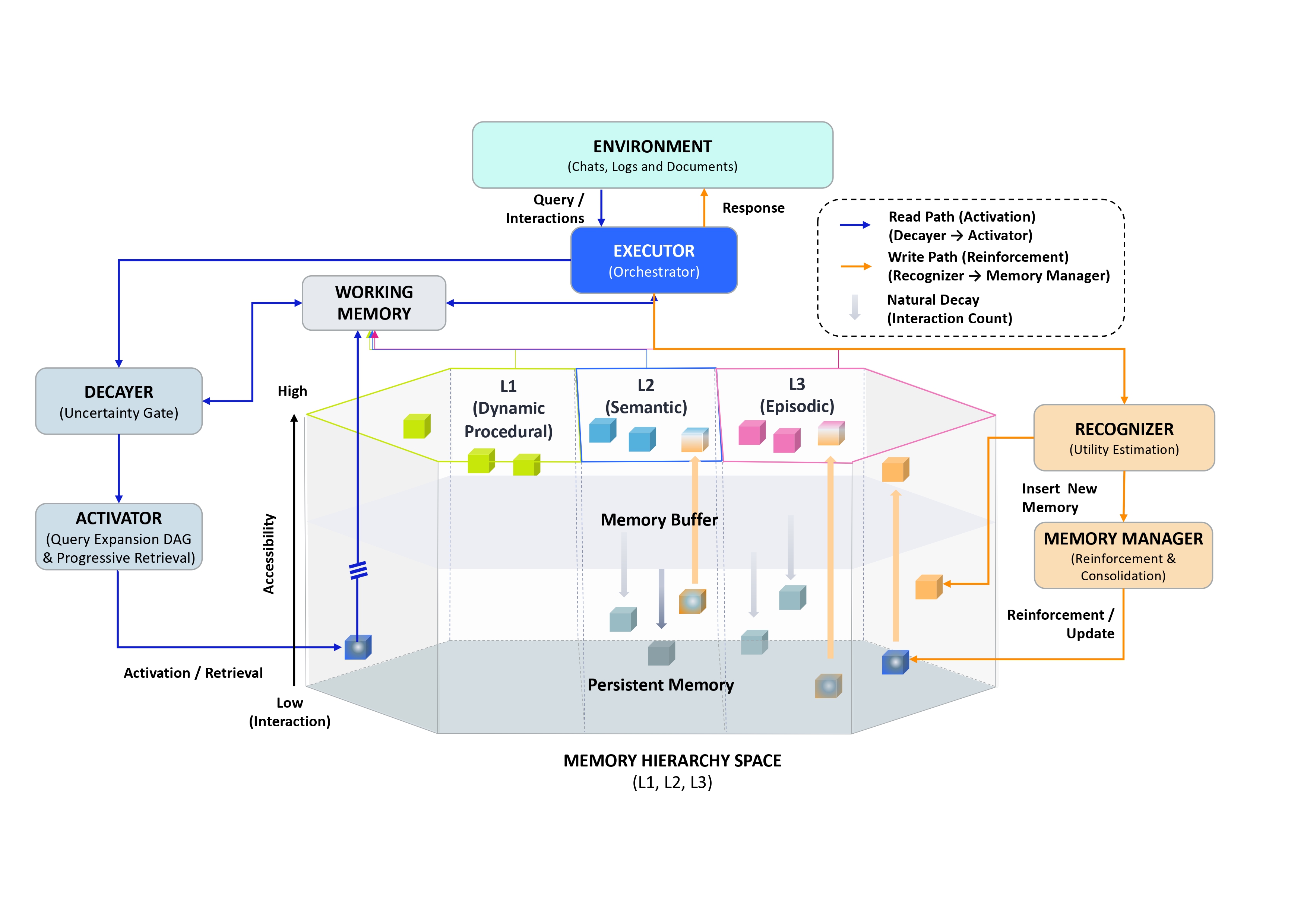
Oblivion is a self-adaptive memory activation framework composed of four cognition modules orchestrated by an Executor agent. Each module can be used standalone or combined into a full pipeline.
Module Documentation
Functional Description
System architecture, problem statement, and design principles of the Oblivion framework.
Executor Agent
Orchestration flow, thinking loop, metrics reference, and the full cognitive pipeline.
Decayer Module
Uncertainty assessment, Ebbinghaus decay, two-tier uncertainty model, and routing decisions.
Activator Module
Query expansion DAG, memory retrieval, RRF curation, and buffer merging.
Recognizer Module
Memory extraction, utility assessment, topic construction, and reward criteria.
Memory Manager Module
Qdrant vector storage, CRUD operations, namespace filtering, and embedding providers.
Execution Flow
The Executor orchestrates a Recognizer-first pipeline. Every interaction begins with the Recognizer extracting memories, then conditionally enters the Decayer→Activator thinking loop for questions or rule statements.
Running Example
Consider a user saying: “I visited Tokyo last autumn and spent two weeks exploring the city.”
- Recognizer classifies this as a
STATEMENT, extracts a semantic memory (“User visited Tokyo last autumn, two-week trip”), and assigns it to thepersonal_lifecluster. - Decayer is skipped — statements do not trigger the thinking loop.
- Memory Manager stores the new memory in Qdrant with an initial utility score.
- Response generation uses the current buffer context.
Later, the user asks: “What places did I visit on my last trip?”
- Recognizer classifies this as a
QUESTION. - Decayer evaluates buffer sufficiency — Tier 1 (LLM) and Tier 2 (cosine similarity)
both indicate high uncertainty →
requires_activation=True. - Activator expands the query into sub-queries (e.g., “travel experiences”, “trip locations visited”), retrieves the Tokyo memory from Qdrant, and curates the buffer.
- Response generation uses the enriched buffer — the agent recalls Tokyo, Meiji Shrine, and Shinjuku.
- Decay reinforcement — the Tokyo memory’s decay score is boosted because it was used.
If the user immediately asks the same question again, the Decayer determines that the buffer already contains the relevant memories (HIGH confidence), so the Activator is not triggered — the response is generated directly from the existing buffer.
Metrics & Logging
Oblivion provides four logging mechanisms at different granularities. See the Executor documentation for the full metrics reference.
| Logger | Granularity | Output |
|---|---|---|
| IntermediateLogger | Per-interaction snapshots | intermediate_*.json — Decayer/Activator/Buffer states, judge scores |
| DecayTracker | Per-memory timelines | Decay score evolution, reinforcement events, access counts |
| ActivatorTracker | Trigger patterns | Trigger rate, uncertainty levels, cluster patterns |
| MetricsCollector | Aggregated run-level | Mean/std/p50/p95 for latency, tokens, judge scores |